Wednesday, December 21, 2005

Drivers exploited by high insurance costs :: Emirates Today

Quote:
Companies in the UAE are charging more than they are legally allowed for car insurance, thereby encouraging many drivers to take to the roads uninsured.

Some companies are raising the cost of insurance despite a federal law prohibiting them from charging more than five per cent of the value of the vehicle.
"Exploited" is a word for the editorial page, not the news page.

These appear to be the facts: Some insurance companies decline to insure some kinds of automobiles at the legal maximum premium of 5% of their value. They either quote a higher rate, or do not offer insurance those kinds of cars.

Some things are not clear from the news report. Is it legal for a company to refuse to quote? If - as the article suggests - insurance companies are making profits, what are the conditions of entry into the market? And who determines what the value of the automobile is?

The more plausible storyline for this article is that the 5% limit on premiums is so low that for some kinds of automobiles the numbers of car owners seeking insurance is more than the insurers are willing to provide. In short, there is a shortage created by a government imposed price ceiling.

Why are insurers willing to charge 5 percent or less for some cars and not others? Because not all cars are created equal and some cars are more likely to be driven by drivers with poor driving records. Some cars are more expensive to repair per dollar of value (one example would be older cars). And we can all name cars that are favored by reckless drivers.

Emirates Today is asking insurance companies to bear the costs that some consumers create by choice of the kind of car they purchase and the way they drive it. Who is exploiting who?

Aside: In the quote above it is stated that some drivers are choosing to go uninsured. Note that when an uninsured driver is at fault in an accident the other driver is harmed twice - by the inconvenience of the accident itself and the hassle created because the uninsured driver is uninsured. Unfortunately, there is really no good solutions to uninsured drivers unless you are willing to adopt severe penalties for driving uninsured.

Labels: ,

Saturday, December 17, 2005

Dubai Education Council reviews strategy

Quote:
Shaikh Mohammad was speaking while presiding over the meeting of the Dubai Education Council. The council reviewed a report on mechanisms to implement its strategy to develop and modernise education.

He said the human element plays a key role in implementing the education development strategy and upgrading the level of education of its various branches and stages, to further develop the performance of teaching and administrative staff at both private and public schools in Dubai.

Wrong:

Education will not change until graduates get paid based on what they know rather than who they know.

Education will not change until educators can assign grades based on what the student knows without fear of retribution.

Education will not change until good teachers see that the system rewards good teaching and roots out poor teachers.

Labels: , ,

Tuesday, December 13, 2005

Ajman tops in rents increase in UAE :: TradeArabia
70% in one year

Quote:
According to an annual research by Dubai-based property services company Asteco, the average increase in rents for two and three-bedroom apartments in Ajman was 69 per cent and 76 per cent respectively.
A lot of this increase in price is driven by the increase in demand for Ajman apartments due to renters fleeing the rent increases in Dubai. A toll to enter Dubai would dampen demand for Ajman apartments and trim the ranks of those who work in Dubai but live outside in neighboring Sharjah or Ajman.

For readers who are not familiar with the UAE, the city of Dubai abuts the city of Sharjah in the neighboring of Sharjah. The tiny emirate of Ajman in turn abuts Sharjah city. All three lie on the Gulf. Many people live in Sharjah or Ajman and commute to work in Dubai.

Labels: ,

Sunday, December 04, 2005

Outta gas! in Oman :: The Muscatis

Quote:
Petrol stations have been running out of gas for the past few days. Yesterday I had to drive to three stations till I found one with petrol to fill in. We got a call from someone who works in one of the oil companies about ten days ago warning us that a shortage was coming up and we should't let our car tanks empty. I guess I should have listened to his advice, but a week had passed since he told us and things seemed to be normal till all of a sudden yesterday one station after another started turning away customers.

Apparently the three filling station companies are alloted quotas by Oman Refinery based on orders which they give in advance every three or four months. The last time they placed orders was before the UAE increased their fuel prices and now due to the large numbers of UAE residents in border towns like Buraimi who come in to fill their cars in Oman the petrol supply is running out before the end of the quota period.
This is the sort of thing that gets the economist's blood pumping. And you read it first in Muscati's blog, not the newspaper.

Interesting lesson for those traveling from the UAE into Oman: you may want to tank up with more expensive UAE gasoline before entering Oman.

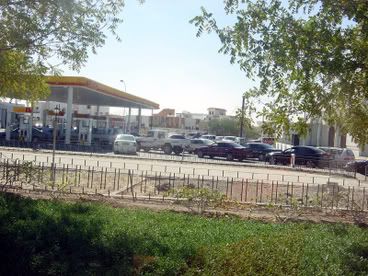
UPDATE: Coincidently travelled to Oman today to visit Hanging Gardens. Below is a photo I shot of the gas line at the Shell Station - it may be the station Brn mentions in the comments.
Image hosted by Photobucket.com
Most of the cars in this line are from the UAE. I enjoy the irony of residents from an oil-rich country country like the UAE crossing the border to buy gasoline cheaper in Oman. I suggest the only solution is for Oman to raise the price of gasoline. Not wishing to wait in line we made sure to refill while still in the UAE.

Another picture here.

Labels: , ,

Saturday, December 03, 2005

Nationality and the rental market :: Khaleej Times

Landlords believe that some nationalities make better tenants than others. They also believe that many persons prefer living in neighborhoods with others of their nationality.

This has always been so. Yet the article was given the headline "Now, landlords turn choosy on tenants nationality." Perhaps that's because discrimination has become cheaper to exercise now that government rent controls have been put in place, creating an apartment shortage. When there's a line waiting for your services, and you can't raise the price, then you can afford to be choosy.

Labels: , , , ,

Monday, November 28, 2005

MOE changes: insider scoop :: An Emarati's Thoughts

An Emarati says he's got the scoop on what Shaikh Nahyan Al Nahyan has planned to shake up UAE government schools. The plan An Emarati outlines makes sense.

As is true anywhere (my comparison is with the U.S.) the greatest difficulty will be to make the plan work in the rural areas where there isn't competition, and it is difficult to attract the best teachers.

What I advocate for university-bound products of the government schools is a year or two of study at a prep school (where the prep schools are vying for students, and part of this vying is success in placing them in universities) before going on to university. But that won't address the problem of the disproportionate number of males who quit school before graduating high school.

Labels: , , ,

Saturday, November 19, 2005

Editorial: For the benefit of the nation’s future more money should be spent on education :: Gulf News
A call to arms

Quote:

the very environment of the schools is stultifying and not conducive to the purpose of education.

To make matters worse, insufficient time is provided to the teaching periods and terms, while too many holidays are given, creating a general apathy towards the process of learning, resulting in a very high drop-out rate, especially among boys.

The whole government attitude towards basic education facilities must be changed and more funds made available to ensure a higher standard of, and more interest in education is attained.

See also this excellent analysis by Dr. Elia Zureik.

If the UAE mobilized and resources as if it was going to war for education would that radically change outcomes? Is it possible to argue that the UAE education system, while not perfect, has come remarkably far in a short amount of time? Is it surprising that in that time a bureacracy has settled in that makes it difficult for a Minister of Education to institute reforms?

Would outcomes change much if there were greater success-in-life consequences to students who do not take their schooling seriously? And if so, isn't that beyond the control of the Ministry of Education?

What do my readers think?

UPDATE: WAM reports
The United Arab Emirates is bent on adopting an aggressive strategy to ensure that students at schools are well prepared for higher education, says the country's Minister of Education, Sheikh Nahyan bin Mubarak Al Nahyan.
. . .
"About a third of our budget for higher education is spent on teaching students the knowledge and skills they should have already learned in secondary schools." "This," he said, "is a terrible waste of money and time. Our main priority is, therefore, preparing students to meet world standards of learning."
. . .
While the Minister focused much of his remarks to the role of the Government in education, he also stressed that the private educational sector also had an important role to play. Private schools, he suggested, help to point up the need for a reform of public sector education.
I hasten to add that in the U.S., higher education also devotes considerable resources to remediation of skills that should have been gained in high school. Reforming an education system is not easy.

Labels: , ,

More cases of absconding workers being reported :: Gulf News
Enforcement is not costless

Quote:
Dubai: Companies trying to avoid paying heavy new fines for allowing their workers' labour permits to expire are increasingly reporting their employees have fled or absconded. The Ministry of Labour and Social Affairs had in August increased the fines for companies to Dh5,000 for not renewing labour permits that had expired more than a year ago.
. . .
many workers still say their bosses falsely report they have fled, a move that leaves them with a year-long ban and no end-of-service benefits. It is a persistent accusation by workers, but labour officials involved in ruling on absconding cases refuse to comment. Even though company representatives file cases where workers have absconded, the burden of proof is on the worker to show he or she has not absconded.
Notice that whether or not there is an enforceability problem for the government to implement its own rules, there is also a problem of enforcing private contracts. Businesses that take advantage of their workers damage all businesses in the UAE. Legitimate businesses prefer a legal system where the promises they make are believed because they are enforceable.

Labels: ,

Thursday, November 10, 2005

France prepares to deport foreigners guilty of rioting :: NYT
'it was easier to find informal work without it'

Quote:
PARIS, Nov. 9 - Struggling to restore order after nearly two weeks of nightly street battles and car burnings, the French government demanded Wednesday that foreigners found guilty of rioting be expelled from the country, regardless of whether they are in France legally or illegally.
. . .
The government's imposition of curfews has been widely popular here, and when Interior Minister Nicolas Sarkozy called for the swift deportations, he was applauded in Parliament.

Mr. Sarkozy said 120 foreigners, some here legally, had been found guilty of rioting since the unrest began outside Paris on Oct. 27.

"I have asked the prefects to deport them from our national territory without delay, including those who have residency visas," he said.

Human rights groups objected, saying such "collective expulsion" was both illegal and needlessly provocative.

It does not go beyond existing French law, however, according to an immigration lawyer, Stéphane Halimi. Foreigners convicted of a crime are subject to losing their residence permits, and they are often deported after serving their sentences in French jails.

"If he can prove that these people constitute a grave threat to public order, he can certainly do it," Mr. Halimi said.

Nevertheless, Mr. Sarkozy's unyielding tone dramatized yet again the deep gulf between the rioters - most of whom are teenagers of North African or West African origin - and mainstream French society.

Many of these young people were born in France and are thus French citizens. But some older immigrants never obtained citizenship because they were ineligible or, in a few cases, because it was easier to find informal work without it.
. . .
The euro slipped against the dollar again on Wednesday, as traders worried about a contagion of violence in Europe.

The French economy itself seems unlikely to suffer much, aside from a potential drag on consumer confidence if the mayhem goes on, according to Nicolas Sobczak, an economist at Goldman Sachs in Paris. More significantly, he said, it could influence France's future economic policy, shifting the emphasis away from budget-cutting to increased social spending.

"The riots will probably change the focus to more social programs and better treatment of the suburbs," Mr. Sobczak said. "The main consequences of this will be political, not economic."
Analysis:

It will be unfortunate for the future of France if there are not consequences for economic policy.

More social programs for the suburbs are a salve. It does not get at the root problems. Some of those problems are social - France is a pot, but it's not melting. Others are economic, and have to do with excess government intervention into employment relations that lead to unemployment, principally amongst those at the bottom of the economic ladder - the foreign immigrants. This in turn only exacerbates the various social reasons the foreign immigrants are not being integrated into the fabric of French society.

In the NYT quote above there's a wonderfully unwitting hint of the heavy hand of government regulation of employment relations : "older immigrants never obtained citizenship because they were ineligible or, in a few cases, because it was easier to find informal work without it."

Informal work is simply work that avoids the radar of government regulation. Why accept work in the informal sector? Because employers can't afford to hire a low-skilled worker and provide all the mandated benefits the government requires.

Remember the Polish plumber.

Labels: ,

Tuesday, November 08, 2005

Employers allowed to loan jobless workers for a year :: Gulf News

When you choose to be a guest worker in the UAE you are confined, by the government's regulations, to contractual terms that limit your job mobility within the UAE. This is especially the case if you are a low-wage worker. The labor market regulations have been so rigid that it is regarded as a sign of increased flexibility that employers are now being allowed greater freedom to rent their workers to other firms.

I mention this news, because James Zogby is drawing some parallels between GCC guest workers, and the conditions faced by those who are rioting in France. Here's the full AFP report (no link yet; I will trim the following to key quotes if and when I find one):

French riots could be mirrored in Middle East: activist

MANAMA, Nov 7 (AFP) - Millions of expatriate workers facing maltreatment and injustice in the Middle East and the Gulf are a "time bomb" that could unleash riots like those rocking France, an Arab-American activist warned Monday.

"France and the rest of Europe are learning now that 'guest workers', in their third generation and still denied justice, are not only a shame that eats at the moral fibre of a society, they are also a time bomb waiting to explode," said James Zogby, President of the Arab American Institute.

France has been shaken by eleven nights of urban violence, involving gangs of youths from low-income and often largely North African and sub-Saharan immigrant suburbs expressing discontent at what they say is their alienation from mainstream society.
"In this region, as well, in many places, workers, be they Palestinians or other Arabs or south Asians, are trapped in horrible conditions, denied justice and their basic humanity," Zogby told a meeting of Arab NGOs here.

"It hurts not only them, but the image and the moral fibre of the countries which host them. We must do better. They clean your offices, build your cities and yet remain invisible. You must see them, incorporate their rights into your vision and defend them," he said.

"Societies, even those claiming to be just societies, are often built on the backs of an underclass ... What is happening in Paris now happened in the United States in the 1960s," Zogby said.

More than 10 million foreign workers and three million of their family members live in the energy-rich Gulf Cooperation Council (GCC) which groups Bahrain, Kuwait, Oman, Qatar, Saudi Arabia and the United Arab Emirates (UAE).

Over the past few months, thousands of low-paid Asian workers staged protests, some violent, in Kuwait, Qatar and Dubai in UAE, for maltreatment and not receiving salary on time.

Foreigners in GCC states are bound by the "sponsor" system, a regulation that restricts the workers' movements and puts them at the mercy of their employers, cited as the main cause for their plight.

It is adopted by all Gulf states and has been blasted by humanrights bodies as akin to slavery.
A couple of observations:

1. Iraq's invasion of Kuwait taught the GCC countries a lesson about the dangers of employing fellow Arabs as guestworkers. Today they rely much more on guestworkers from the India, Sri Lanka and other Asian countries. Fellow Arabs are more likely to perceive themselves as deserving an expansion of rights.

2. Unlike the situation in France, the guestworkers in the GCC have jobs. The riots in France are due to lack of jobs.

3. Unlike the situation in France, the GCC guestworkers live with the fact that they can be readily deported.

4. In France discrimination is claimed as a reason for rioting. Discrimination is least costly to the discriminator when there is unemployment and an employer has the choice amongst many qualified job applicants. Why is there such high unemployment in France? Because of excessive government regulation of the labor market.

5. Notice that the GCC countries are discriminating against low-wage Arabs by not letting them into their countries to work.

Labels: , , , , , ,

Wednesday, November 02, 2005

Migrant laborers build Arabian Metropolis :: San Jose Mercury News
Al Hamed gets more international coverage

Quote:
The Al Hamed construction labor camp is a hardscrabble jumble of battered trailers, where 7,800 laborers sleep, cook meals, and kneel to pray in an outdoor pavilion of corrugated tin.

The camp lies on Dubai's desert outskirts, out of view of the wealthy foreigners in the Gulf shore skyscrapers and the tourists thronging to mall boutiques like Prada and Gucci.

The workers in this camp, however, know the city's luxurious attractions. They built them, on salaries that range from $135 to $400 a month.

Despite their paltry wages, and despite the tens of billions of dollars in oil revenues pouring into the United Arab Emirates, laborers sometimes have trouble coaxing their employers to pay up. Three to five months without pay is common. Some say they have not seen salaries in a year or longer.

In the past, the docile immigrant work force had little redress. But this year, thousands have walked off construction sites, blocking roads, marching in protest to the Labor Ministry or simply refusing to work.

"Any worker who doesn't get paid should go on strike," said a 33-year-old Indian man visiting the Dubai Court's labor section who gave his name only as Zia, for fear of being fired and deported for speaking to a reporter. "You have to go on strike, because it is successful."

Zia was one of a dozen laborers filing grievances last month for as much as six months' back pay.

The protests have galvanized the federal Labor Ministry into cracking down on the offending companies, saying they are tarnishing the reputation of the country. . . .
All this should be familiar to those who follow the news in the UAE.

The following has received less attention. Picking up where we left off:
The protests have galvanized the federal Labor Ministry into cracking down on the offending companies, saying they are tarnishing the reputation of the country just as it negotiates a free trade agreement with the United States. Workers' rights are a critical factor in those talks.
. . .
Human Rights Watch and the State Department have criticized the Emirates and other Gulf countries as centers of human trafficking and worker exploitation. In Saudi Arabia, Human Rights Watch in 2004 said some Asian migrants worked in "slavery-like conditions."

The State Department last month upgraded its assessment of the Emirates and Qatar, but they remain on a watch list. Saudi Arabia and Kuwait still face sanctions that can only be waived by the president.

The Emirates has a big impetus to treat its workers better. The free trade pact it is negotiating with the United States stands to make this business-savvy country even more wealthy. Dubai is a duty-free trading hub, with some of the world's busiest air and sea ports. Washington has already signed free trade pacts with Bahrain and Oman that remain to be ratified by Congress.

Holding up the deal are U.S. demands that would give workers the right to form unions and bargain collectively, Alkhazraji acknowledged. He said trade unions could have huge economic consequences for the Emirates, perhaps slowing the building boom while radicalizing the docile work force.
The irony for these workers is that if they are given more bargaining power many of them will lose their jobs. At higher wages the UAE would substitute in obtaining its construction workers from more other countries with a more skilled workforce.

Question to self: What are foreign worker rights in Iraq? Where do most of the foreign construction workers there come from?

Labels: , , , , , ,

Monday, October 31, 2005

Current Labor Market Regulations for Women in Saudi Arabia: Beneficial or Detrimental? :: Arab News

Here's an advocate for women's rights to equal opportunity in the workplace who recognizes that sometimes rights hurt the ones they are intended to benefit:
One salient article in the new law caught my attention, both for its good intentions, as well as its miscalculated judgment; the one that imposes an obligation on employers to provide childcare to women once they have 50 women on their payroll. Now the intention behind such an article is fair and practical — for a well functioning child care market is indispensable if women are to combine work and family responsibilities — but unfortunately, the method by which the article is to be implemented is outdated and discriminative.

In practice, such a regulation only serves to raise the cost of women’s labor relative to that of men, and thereby is nothing more than disincentives to the private sector employer.

Allow me to explain. (
continue reading)
The author is Fatin Yousef Bundagji, director of The Women Empowerment & Research Department at The Jeddah Chamber of Commerce & Industry.

Bundagji recommends that government should mandate greater employee benefits for Saudi women and men.

I recommend equal benefits for Saudi women and men, but not a mandate of higher benefits. Benefit mandates lower wages; families are in a better position to decide how best to budget their income.

Further, I recommend the Saudis take a good look at the social restrictions on the kinds of jobs that women are allowed to take. Those restrictions are exceptionally narrow.

Labels: , , ,

Friday, October 28, 2005

Your Misery is OUR Gain! - Over inflated Gas Prices mystery solved!! :: TruthBeFree - Collective Bellaciao

Regular readers will recognize the headline could hardly be mine. It is the headline Collective Bellaciao gives to a recent widely-published Associated Press article on oil company profits:
Exxon Mobil Corp. rewrote the corporate record books Thursday as the oil company’s third-quarter earnings soared to almost $10 billion and it became the first public company ever with quarterly sales topping $100 billion. Anglo-Dutch competitor Royal Dutch Shell PLC wasn’t far behind, posting a profit of $9 billion for the quarter.
. . .
To put its performance into perspective, Exxon’s revenue for the three-month period was greater than the annual gross domestic product of some of the largest oil-producing nations, including the United Arab Emirates and Kuwait -- even though it lost considerable production because of a string of hurricanes that battered the U.S. Gulf coast.
Eye-popping numbers, yes. But what's the story behind them?

Short-run demand for petroleum is inelastic, meaning that a fall in supply translates into a percentage increase in price that is greater than the decrease in quantity consumed. As a result, negative supply shocks drive up revenues and can drive profit as well. What does this prove? That despite its size Exxon and its fellow producers were not exploiting market power - otherwise they would have done on their own what a string of hurricanes did instead.

The article continues:
Those results led Democrats in Congress to demand a new windfall profits tax. "Big oil behemoths are making out like bandits, while the average American family is getting killed by high gas prices, and soon-to-be record heating oil prices," Sen. Chuck Schumer, D-N.Y., said in a statement.
Right. Good plan. Very original. Tails you lose, heads I win.

Not all shocks are negative supply shocks. It is only because government has been able to maintain a reputation not to grab profits that oil producers invest in exploration and production.
Which brings up another contributing factor behind the high prices at the pump: Government environmental restrictions that have stopped investment in refining in the US dead in its tracks for decades.

It's no wonder that OPEC members are considering expanding their investment in refining in the rest of the world.

Labels: , ,

Thursday, October 27, 2005

UAE nationals brain drain, but with a flip side :: Khaleej Times

Quote, emphasis added:
Two out of three UAE nationals who leave the shores of the country are skilled workers, a sure indication of brain drain having taken roots in the UAE.

According to the [World Bank] report, the UAE ranks a high fourth in the list of nations losing out skilled workers to other countries, with 67 per cent of the UAE nationals seeking jobs in other countries falling under the educated category.

On the flip side, the UAE, however, fares better in retention of nationals, accounting for one of the lowest rates of migration across the globe.

In the rankings for the ratio of skilled migrants to overall migrants in the year 2000, Qatar and Kuwait are ahead of the UAE, occupying the second and third places respectively behind Taiwan. Saudi Arabia is in the seventh place and Oman ninth, meaning that the top 10 are made up of five GCC countries.
. . .
The findings are likely to create a sense of ambivalence for the UAE Government. On the one hand, the low rate of migration could be read as "all is well," and on the other, it could be a matter of concern that those who do leave overwhelmingly tend to be the most educated workers.

Since the report covers workers aged 25 and above, the migrants do not include the bulk of those who temporarily go abroad to school and university.

It is likely that one reason for the high percentage of skilled workers opting to stay out could be the potential mobility of educated UAE nationals who have internationally-recognised qualifications. The Government could also highlight the large influx of skilled labourers who move to the UAE as redressing the loss of homegrown educated people.

No one at the Ministry of Labour and Social Affairs could be reached for comment.
The UAE has enormous wealth and shares that wealth with citizens residing in the country. It's not surprising the UAE has one of the lowest rates of emigration.

The question is why would anyone leave? Part of the explanation surely is that rewards to UAE nationals in the UAE has little to do with merit. Moving to a country where rewards are more closely tied to educational achievement and work effort will be most likely be attractive to those with skills.

Where the brain drain is serious is in places like Iran.

Labels: , , , , , ,

Sunday, October 23, 2005

Freehold law 'need of the hour' :: Gulf News
Buyer beware

Quote:
Dubai : Absence of freehold law and formal regulations are likely to discourage buyers of freehold properties in the coming days, following a dispute between Emaar Properties and some customers living in Dubai Marina.

A dispute over service charges is forcing potential buyers to reconsider their decision or wait until the laws are in place. Most developers do not declare service charges at the time of sale, but fix them later at a higher-than-expected price, to the dismay of the homeowners.

"This is happening due to the absence of transparent legislation and lack of regulation in the market," said an eminent lawyer, requesting anonymity.

"Further delay in issuing property laws to regulate the growing freehold market will create more confusion and uncertainty among new investors; also it will allow certain developers to take the customers for a ride.

"This is a wake-up call to homeowners and a lesson for new investors to force the developers to mention this in the contract."
I agree that there is ambiguity surrounding freeholds. With ambiguity comes a responsibility for buyers to look for hidden costs that have not been spelled out by the seller.

It sounds as if contracts did state that service charges would apply for services for the upkeep of common property, but did not spell out the level of those charges. And it was left open how those charges would be set - and, equally important, how it would be determined that promised services were delivered. These are issues that are difficult to deal with in any legal setting.

Would a freehold law be a sufficient remedy? Law is not a magic wand. Isn't a well-developed independent judiciary as important? A freehold law might have some benefit in simplifying enforcement by bringing standardization to contracts. But it would not itself develop a judiciary that could enforce contracts, and it would not necessarily address the question of enforcement when there is substantial government ownership in companies such as Emaar.

Emaar is a large company with many properties. It has an interest in maintaining a reputation for honest dealing. (And Dubai's reputation is linked to Emaar's.) Thus, it is not necessarily the case that there is a need for a law or for a judiciary. Rather what is necessary is that Emaar can build and maintain that reputation. To do so it needs to demonstrate that it is carrying out the spirit of the contracts it enters into. And it needs to monitor the claims and promises of its sales agents.

Emaar may be doing all those things. It also has an interest in making contracts straightforward to external interpretation. Otherwise, it risks losing its reputation when buyers' complaints about high service charges have more to do with every buyer's preference for a low price than with a failure on Emaar's part.

Labels: , , , ,

Wednesday, October 19, 2005

The desert shall bloom :: Financial Times
Trading hubs in bud

Quote:
if the government has its way, the Gulf emirate will soon become a global floriculture logistics hub - potentially threatening Dutch pre-eminence.

At the end of this month the Dubai Flower Centre (DFC) opens its doors and by early next year hopes to be attracting international shippers and wholesalers.

By routing their goods through tax-free Dubai - whether South African proteas, Kenyan green beans, Malaysian bouquet foliage or Sri Lankan orchids - shippers would be able to cut time and money off the chain linking 15 producing nations to Asian and Middle Eastern consumers.
. . .
Where once an east African rose would have travelled north to Amsterdam to be auctioned, packaged and flown on to a Tokyo florist, in theory it will soon be able to arrive faster and fresher by heading directly eastwards. Until operational, however, DFC officials are refusing to estimate potential cost or time savings.
. . .
Ian Strachan of Zurich-based ADI Consulting, the company contracted to manage the DFC, says east Asian flower shippers "want to shorten delivery times from African producers, but can't do that without the ability to sustain the cool chain".
. . .
"I think if the Dubai centre is successful as a handling depot, then it will be a big blow to the Netherlands," [Quint Wilken, managing director in the Netherlands for the Cool Chain Group] said. "If it also becomes an auction house, then that will be a disaster for people here."

The DFC has shelved plans for an auction house in the first phase, but has not ruled it out at a later stage.
. . .
"I expect some exporters will be interested, once they see how Dubai develops as a hub," [Felix Schrandt, chief executive of the Flower Council of Holland] said. "It took the Netherlands half a century to build its horticulture export industry though, so I don't believe that can be copied overnight."
As the article illustrates, the logistics and the market-making sides of trading hubs are mutually reinforcing. Holland of course is a major flower (think tulips) exporter and the flower market grew up around the export hub. There is a long history here. The existence of this well-established market made Amsterdam attractive as a hub for trade in other flowers not grown in Amsterdam, but in far-flung parts of the world. Buyers and sellers are both interested in getting the best price so they come to the market. And a hub where a variety of flowers come together facilitates the logistics of repackaging shipments from farm through to retailers.

What Dubai is trading on is that there are costs of shipping to the hub and then back out to retailers. Savings on these costs raise the possibility that another hub could be economically successful in the long term. Perhaps Dubai can successfully reverse the order of development of Holland's hub. Success, I think, will be judged in terms of whether the Dubai becomes a center not only a point in the cool chain, but also develops into a flower auction center.

Labels: ,

Plan to set up fund to help unpaid workers :: Gulf News

A colleague sent along this link with the comment "how about this for moral hazard"?

The image of the UAE has been tarnished by employers who have failed to pay wages for employees for months at a time. My recommended solution has been to give the employees more leverage by giving them the right to change jobs. Among the virtues of allowing labor mobility is that the incentive to collect remains with the workers.

Dubai wants to preserve the buzz it has developed and is concerned with the problem of employers failing to pay. Dubai's proposed solution is to create a fund to help workers when their employer fails to pay. The downside of such a plan is that it undercuts the incentives of potential employees to choose reputable employers. And it encourages employers to gamble on riskier ventures without fear that this would mean they would have to pay workers more to participate in these ventures - the workers would calculate that if the firm fails they will still get paid for services performed; the firm will calculate that if the venture succeeds it will not have to share its gain with the fund.

Labels: , ,

Tuesday, October 18, 2005

Cement prices up 7% :: Khaleej Times

Cement. A mundane product. But in the context of the building boom in the UAE it's quite important.

Cement is heavy, hence the recent increase in fuel prices in the country have pushed up the cement producers' cost of transporting the product within the country. Customers tend to understand these price increases.

When increases in price are driven by an increases in demand, customers often complain these price increases are not justified. What they have in mind is that if the cement producers expanded and invested in new plant and equipment it should be possible to produce to satisfy the growth in demand with little or no increase in price. What is omitted from this thinking is that cement producers are aware that the construction is cyclical. They do not want to be left holding a lot of excess capacity when demand recedes. Implicitly builders are demanding that cement producers share in the risk that the boom will go bust.

The article mentions that last year the government placed a price ceiling on cement. The result was a shortage; no surprise there. What is not clear is whether the price ceiling is still in place and these announced increases in price represent an adjustment in the ceiling due to the recent increase in the price of fuel.

Labels: , ,

Sunday, October 16, 2005

Earlier today I posted links to newspaper coverage of the last night's majlis in Dubai on the subject of unemployment amongst UAE nationals. Here's a bit of analysis, set up first with some quotes.

From the Gulf News:
Lieutenant General Dahi said the number of unemployed nationals increased from 8,000 in 1995 to 24,000 in 1999 to 30,000 in 2003, and 35,000 in 2005. He said the number of nationals who enter the job market varies between 1,500 to 2000 unemployed nationals every year.

Emiratisation in the federal government is 54 per cent, and in the local government it is 15 per cent, while the percentage of nationals in the private sector is currently one per cent only.
From the Khaleej Times:
Endorsing the sentiments expressed by the top police official, Khaled Al-Qassim, Deputy Director General for Planning Affairs in Dubai Economic Department, pointed out that the Ministry of Labour was engrossed in aspects other than the unemployment dilemma, such as visas and labour issues, which are within the jurisdiction of other establishments like the naturalisation and residency administration.

He stressed the importance of establishing a ministry for workforce to look after the affairs of the nationals and to set forth strategic plans for the labourers as adopted in the developed countries. Such plans, he noted, determine the number of foreign workers needed in the labour market according to the required specializations. In the light of these statistics, the emigration ministries issue visas for the required number of labourers, he added.
. . .
Dr. Najeeb Abdullah Al-Shamsy, Director General of the economic department in RAK, affirmed that unemployment is an international phenomenon and the developed countries are keen to keep it within its normal limits.

He said that a minimum salary ceiling [floor?] for nationals in the private sector must be determined, as there are more than 5000 jobless nationals in RAS [RAK?], though they are university graduates. This necessitates carrying out various projects in the northern emirates and the distant areas to encompass the large number of graduates, he added.
Actually, a minimum salary for nationals, above what the private sector currently offers, would discourage the private sector from employing nationals. I sense that what Dr. Al-Shamsy could have in mind is that nationals are reluctant to accept the salaries that are currently offered in the private sector, and more would be more likely to accept private sector employment if salaries were higher.

But because this minimum salary would make nationals less attractive to the private sector, this will only increase unemployment amongst nationals. This is where Mr. Al-Qassim's suggestion of limiting the number of foreigners workers in each specialization would come into play. If these limits were sufficiently tight, then the private sector would be willing offer positions to nationals at at least the minimum salary. At the same time, however, firms would reduce total employment. Production would fall and the price of nonimported goods would rise - an undesired effect.

The government should think about policy changes that would bring down the wage demands of unemployed nationals. In particular, it should consider reform of social assistance. At present the amount of social assistance you receive declines as your earned income increases. If the amount assistance was independent of income, then unemployed nationals would accept work at lower salaries.

Labels: , ,

Tuesday, October 11, 2005

Sharjah taxi fares up :: KT

Dubai and Sharjah taxis have raised fares. Not surprising given the 35% increase in petrol prices.

Quote:
Following in the footsteps of Dubai Transport Corporation (DTC), the Sharjah Transport Corporation (STC), too, has decided to adjust taximeters, effecting an increase of 10 per cent in the fare. Speaking to Khaleej Times, an STC official said that Dh1 would now be levied after every 800 metres instead of the earlier 900 metres. "The decision will be implemented in a few days time," he said, and confirmed that there would be no change in the starting fare, which would continue to be Dh2.
More:
"Drivers who refuse to take passengers to their desired destination are fined between Dh100 and 200," he said, adding that, at present, the corporation had 2000 drivers.
Why would drivers refuse to take passengers to their desired destination? If the driver is not compensated entirely by salary, but shares in the revenue or net revenue the driver would decline to take a passenger to a time-consuming destination or a destination where he or she is not likely to find another find another fare. (One case of the latter is the restriction the emirates have on taxis from one emirate picking up fares in another emirate.)

Put yourself in the shoes of such a driver asked to contend with this.

Labels: , , , ,