Monday, March 07, 2011

PorTgate cum PorKgate

This story in The Nation today is mostly about the plans for the richer GCC countries to put together a Marshall Plan for Oman and Bahrain to address what one official elliptically called "the circumstances that the region is experiencing".

But what really caught my line was this paragraph:
Meanwhile Sheikh Sabah al Ahmad Al Sabah, the Emir of Kuwait, has helped to mediate between the UAE and Oman to "clear the atmosphere" between the neighbouring countries following the arrest last month of what Oman alleged was an Emirati spy ring in the sultanate.
The story of the UAE spying on Oman is something I'd miss. Why would the UAE want to spy on Oman?

It turns out it's industrial espionage, otherwise known as market research.

You can do a Google and find plenty.

Muscati Confidential posted this back in November:
Well, Oman's Government, led by the Ministry of Finance, is investing heavily in a new industrial mega-port complex in Duqm, a previously sleepy coastal town in the middle of nowhere between Muscat and Salalah.
...
As part of that complex, the obvious play for Oman was to add a 'free trade port facility', where goods can be shipped in and out without significant duty or paperwork. The goods can be processed too, and 'value added'. It seems the Abu Dhabi crowd were concerned that the strategic location of the port* would impact the outlook for the UAE's planed free trade zone in Abu Dhabi, and indeed were concerned about the impact on the existing Jebal Ali Free Trade port in Dubai [note: now also effectively owned by Abu Dhabi, post Dubai-meltdown].

So it seems the foreign intelligence arm of the Abu Dhabi Royal family had managed to bribe several Omanis to betray their country and provide intel on the goings on in Duqm.

And how did Abu Dhabi respond? Muscati Confidential says:
The word is the UAE, as a demonstration of their petulance, have blockaded all pork shipments from the UAE to Oman. This is why there is a drastic shortage of nice American and other land imported pork product in Oman right now.

Labels: ,

Wednesday, March 02, 2011

Oman: Analysis from Foreign Policy

Foreign Policy:
Before Sultan Qaboos, at age 29, staged a nonviolent coup against his father, Oman was a forgotten land of mountains and deserts with only a couple of schools, no public health system, few paved roads, and an ancient sea trade in frankincense. It wasn't that it was backward. Oman just had never come forward, and it was too isolated to even be aware of it.

Today, Oman is a vibrant society, a place that values education and technology, a country that is fat on oil, a monarchy with a constitution called the "White Book" that offers a range of protections to its citizens, including equal rights for women and fairly progressive press laws, as long as the sultan is not discussed or disrespected.
...
Many of the young college graduates in Sohar complain that the port city's growing base of foreign companies won't hire them. They may not be going hungry, but in Sohar, young Omanis need only to look into neighboring Dubai to see what they don't have. While their parents reach back proudly to see how far they've come, these young people look ahead and are disgruntled.
...
"The people are not against His Majesty," said Sultan Al Bustani, an oil-company executive in Muscat who was at Monday night's demonstration. "He did a lot for the country. But we need change in the government. We don't have a say."

This was not Muscat's first demonstration in recent weeks. On Feb. 18, about 350 protesters marched peacefully in front of the government ministries, rallying against corruption and demanding to know how their country's oil proceeds have been spent. Protesters carried signs that read, "No to high prices, no to corruption" and "Where is democracy?"
This analysis is plausible, but you have to wonder how informed it is. Oman is not "fat with oil." It has some oil. And, just so we're clear, Oman is country and Dubai is not. Comparisons should between Oman and the UAE, the country, which is fat with oil because of the oil in Abu Dhabi, not Dubai.

Labels: ,

Tuesday, March 01, 2011

Phrase of the week

If I had a dollar for every time I heard Oman called the "Sleepy Sultanate" I'd have enough quite a few dollars. In the last few days its been used by Reuters (twice), Foreign Policy, the Irish Times, AOL News, and the Financial Times. And those are just the ones I've stumbled on without a focused search.

If you google "sleepy sultanate" Oman you get about 5,100 results.

If you confine your google search to the last week you get about 19,400 results. [I have no idea why restricting the time period increases the number of results.]

Labels: ,

Monday, February 28, 2011

Omani protests intensify

One of the stereotypes of Omanis and Emiratis is that Omanis are gentle and easygoing, and Emiratis are pushy and demanding -- and that these traits are deeply rooted culturally. I'm thinking of those stereotypes when I read this report from Reuters:
A doctor said six people had been killed in clashes between stone-throwing protesters and police on Sunday in the northern industrial town of Sohar. Oman's health minister said only one person had been killed and 20 wounded.

Hundreds of protesters blocked access to an industrial area that includes the port, a refinery and aluminum factory. A port spokeswoman said exports of refined oil products that typically amount to 160,000 barrels per day from the port were unaffected.

"We want to see the benefit of our oil wealth distributed evenly to the population," one protester yelled over a loudhailer near the port. "We want to see a scale-down of expatriates in Oman so more jobs can be created for Omanis."

Peaceful protests also spread to other cities, with hundreds of people demonstrating outside a government ministerial complex in Muscat and at another site in the capital.

The unrest in Sohar, Oman's main industrial center, was a rare outbreak of discontent in the normally sleepy sultanate ruled by Sultan Qaboos bin Said for four decades, and follows a wave of pro-democracy protests across the Arab world.
Video of supermarket burning here.

Labels: ,

A blog to follow on the Omani protests

http://dhofarigucci.blogspot.com/

I was most interested in these points:
(11) His Majesty (as of a few minutes ago) announced a monthly compensation package of 150 OMR for each registered unemployed person in the country. Where did THAT money come from?

(12) Rumor has it that His Majesty has also announced the 'creation' of 50,000 jobs. Sounds highly suspicious. Where did the 50,000 come from?

(13) Huge protests expected on Tuesday March 1st all over the country.

Labels: ,

Tuesday, December 21, 2010

Odd "news"

Anyone know more?
abuaardvark
Wild story about busting of Emirati spy ring trying to incorporate Oman into UAE making the rounds.. crazy stuff! (Ar)
The link goes to an Arabic language website, nahrainnet.net. Google translates the headline this way:
Gulf sources: spy network Alamartyp part of the Israeli project to include the Sultanate of Oman to the UAE, the stage of post-Sultan Qaboos
In the original:
مصادر خليجية : شبكة التجسس الامارتية جزء من مشروع اسرائيلي لضم سلطنة عمان الى دولة الامارات مابعد مرحلة قابوس
In other news, Roger Cohen opines about The Captive Arab Mind. Of course, a lot of Americans believe Obama is a Muslim, too.

Labels: ,

Saturday, March 29, 2008

Cement in Oman

Arabian Business:
Oman said on Saturday [March 15] it was considering reducing import duty on building materials in an effort to put a cap on rising inflation in the construction sector.

"We are revising the import duty on building materials to help reduce the cost of cement, steel and wood," Chamber of Commerce and Industry Chairman Khalil Al-Khonji told reporters.
...
Oman had restricted the import of cement two years ago to support the sale of local firms Oman Cement Company and Raysut Cement Company, but the move caused shortage in the market.

Said Al-Barwany, chairman of Al-Barwany Construction, told newswire Reuters Oman needed an extra 20,000 tonnes per day of cement to help reduce the shortage.
The price of cement has doubled in the past year, according to Baljit Singh, a building materials trader.

"A 50-kilogram bag of cement rose from 2.4 rials ($6.24) last Sunday to 3.6 rials today; it is too much. This time last year, it was only 1.3 rials per bag," Singh said.

Meanwhile, Oman Cement is in discussions with the government on plans to raise the price of cement to offset the soaring price of imported clinker, which is used to make cement, Chief Executive Jamal Al-Hooti told Reuters last week.
Muscaticonfidential points to evidence that this is a black market in cement. According to the Oman Tribune,
Two Asians were caught red-handed while selling cement at exorbitant price in the Wilayat of Ibri on Tuesday [March 24].

The two expatriates were selling cement at the rate of RO2.900 per bag.

The arrest was made as part of a campaign run by the Ministry of Commerce and Industry against people manipulating prices.
...
In spite of the Ministry of Commerce and Industry’s continued inspections to check illegal trade practices and the arrests being made by the police, in addition to the authorities’ warning of stringent action against the violators, some traders and their aides have been ignoring the warnings and were selling cement at high prices.
Trade Arabia adds,
Oman Cement Company, the country's largest cement firm by market value, said it is in talks with its government owner about raising prices or possibly face a fall in profit this year.

'If we don't increase cement prices by 1 to 2 rials per tonne, profit might come down in 2008,' Oman Cement chief executive officer Jamal Al Hooti said in an interview in Muscat on Wednesday [March 12].
Black market opportunities for profit exist when buyers cannot fulfill their planned purchases at the official price. In other words, there is a shortage, a gap between the quantity buyers would like to purchase at the official price and the quantity sellers are willing to produce. Frustrated buyers are willing to buy (a smaller amount) at a price above the official price, sometimes much more. The "Asians" had a profit opportunity if they could acquire cement at the official price and resell it at a higher price.

A natural question is how the black marketers came into possession of the cement in the first place. The most innocent possibility is that they were able to purchase it without any favoritism from the original seller be it from a producer or an importer. Otherwise, there is some corruption involved beyond the violation of selling above the official price.

Import duties do not create shortages. They reduce imports, and drive up the domestic price. Shortages are created by price ceilings -- the official price above which it is illegal to sell. These prevent price from rising to bring the quantity demanded into balance with the quantity supplied.

The additional complication in the Omani cement market is that the major domestic producers are government owned. Yet the government-owned cement producers have to obtain permission from the government to raise the price. What they can do, as is evident from the fact of a shortage, is restrict quantity; they are not obligated to satisfy demand for cement at the official price. If their objective is to maximize profit, or to meet a target level of profit, then an increase in the price of an input (in this case clinker) will decrease the amount they are willing to produce at a given cement price.

Reducing the import duty would reduce the shortage. So would raising the official price for cement.

Speaking of cement, is this the headline you'd give this story?:
Growth in cement imports plummets

Growth in cement imports into Dubai slumped 60% last year, state-owned conglomerate Dubai World said on Sunday, without giving a reason for the drop.

Dubai World said cement imports shot up 73.6% to 2.960 million tonnes in 2007, but the growth fell well short of the 184% increase in imports seen in 2006.
My point is, 73.6% growth is enormous growth by any measure.

And finally, on the cement front, the UAE has eliminated the duty on cement and rebar to ease inflation.

Labels: , , , , ,

Monday, February 12, 2007

Recent posts by Muscati

Got gas? Muscati wonders what happened to Oman's natural gas and why has the conversation turned to coal?

Taking it to the street? Economists call it path dependence. Muscati reports: "The hotel closed down three weeks ago for 10 months' renovation in which the whole hotel will be made over. However from the bumper to bumper traffic of cars entering and exiting the hotel's parking lot you'd be excused if you thought it was still open. The reason all these cars are heading to the Sheraton? Lined up on the sidewalk at the hotel's exit is a long line of Chinese prostitutes. ... Apparently, ground central for these Chinese pros used to be the night club downstairs in the hotel. Now that the hotel has closed down they've taken their business outside. It's not like the police are doing anything about it."

Lastly: Got moobs?

Labels:

Thursday, January 18, 2007

GCC plus Egypt and Jordan

Washington Wire:
After numerous meetings over the last year with the six-nation Gulf Cooperation Council, plus Egypt and Jordan, the Bush administration wins a breakthrough — of sorts. The GCC Plus Two, a group the administration sees as a budding front against Iran, issued its first-ever communiqué.

But the statement leaves out any mention of Iran, referring instead to the importance of regional stability and the group’s “collective desire to prevent Iraq from becoming a battleground for regional and international powers.” The intentional omission reflects the sensitivity that that the Gulf countries of Oman, United Arab Emirates, Saudi Arabia, Kuwait, Qatar and Bahrain feel about provoking Iran, the region’s rising power.
. . .
In a slightly more pungent line, the group says it “welcomed the commitment by the United States as stated in President Bush’s recent speech to defend the security of the Gulf [and] the territorial integrity of Iraq.” Bush said in his Iraq speech last week that he was sending another aircraft carrier to the Gulf and would cut off Iranian networks in Iraq.
Also, Saudis pass on the idea of squeezing the Iranian economy by pumping up oil production. Of course, with oil already at $51/barrel, out-of-control governments like Iran and Venezuela will be squeezed and will have to discipline their spending and over regulation.

Labels: , , , , , ,

Saturday, December 16, 2006

Oman opts out of GCC currency union :: Gulf News

Professor Emilie Rutledge's analysis of why.

Labels:

Monday, December 04, 2006

Cost of Living :: GulfTalent news release

Quote:
Monday 4 December 2006, 10:59 GMT

Dubai's Appeal Continues Despite Rising Costs, Study Reports

DUBAI, United Arab Emirates, December 4 /PRNewswire/ --

- Spiralling Living Costs in the UAE Fail to Deter Inflow of Expats

Despite high inflation and the lowest savings rate in the region, the UAE remains the most popular Gulf destination for expatriates, according to the latest research released by GulfTalent.com, the Middle East's leading online recruitment firm.

The report entitled "Pay, Inflation and Mobility in the Gulf" analysed cost of living and employment patterns in the Gulf.
. . .
With the economic boom causing staff shortages across the Gulf, the UAE's immense popularity is further straining the availability of expatriate talent for the rest of the region. According to GulfTalent.com's report, employers in Kuwait, Saudi Arabia, Bahrain and Oman have difficulty attracting professionals in sufficient numbers and many are losing existing staff to the UAE.

Labels: , , ,

Monday, November 13, 2006

Emirates building boom depends on abused work force, Human Rights Watch says :: AP

This Associated Press report has been picked up by local papers across America. An extract:

The Emirates, the watchdog said, "has abdicated almost entirely from its responsibility to protect workers' rights."

The men earn as little as $135 (€105) per month in a country where the average wage is $2,100 (€1,600), Human Rights Watch says. The workers often toil for two or three years to pay off debts to unscrupulous labor recruiters, said the report, titled Building Towers, Cheating Workers.

"There's no reason for a global economic powerhouse like the U.A.E. to tolerate abusive and exploitative labor practices," said Human Rights Watch researcher Hadi Ghaemi. "None of this construction would be possible without these imported workers."

Labor Minister Ali Al Kaabi said the Emirates is beefing up its enforcement of already strict laws on labor rights and human trafficking. Al Kaabi acknowledged there are just 80 labor inspectors — too few to keep companies in line.

"Our laws are tougher than anyone else's in the Mideast," Al Kaabi said. "But the lack of inspectors means sometimes we don't see these problems."

The human rights report, released Sunday in a press conference at a Dubai hotel, comes days after Dubai leader Sheik Mohammed bin Rashid Al Maktoum issued a sweeping program of labor reform that appeared timed to undercut the watchdog group's findings.

And on Saturday the country's ruler, Sheik Khalifa bin Zayed Al Nahyan, announced tough penalties, up to life imprisonment, against trafficking in humans, which has illegally brought domestic servants, prostitutes and even child camel race jockeys into the country.

Now, Sheik Mohammed has ordered the creation of an inspection directorate and a system of labor courts. He also requires companies to provide health insurance for all foreign workers and allow them to change jobs more easily.

Sometime next year, Al Kaabi said a new force of 2,000 inspectors will police this country's building sites and desert labor camps, home to hundreds of thousands of migrant workmen from South Asia.

"We're in the spotlight because of Dubai's development," Al Kaabi said. "Success means you get a lot of criticism."

The Emirates, like other Gulf countries, relies on foreign labor for private sector jobs. Labor conditions are similar in nearby Kuwait and Qatar; worse in Saudi Arabia and slightly better in Oman and Bahrain, Ghaemi said.

While the reforms may cut abuses, they won't do anything to raise salaries, which Al Kaabi said were set by "the market" in India, Bangladesh and Pakistan where wages are a tiny fraction of those in the wealthy Gulf.

Gulf developers use a clever tactic of "in-sourcing" laborers on three-year contracts, hiring men in South Asia on salaries that appear reasonable in their home countries. In many cases, the men go into debt to pay their own airfare and visa costs, even though Emirates law says companies must pay these fees. Workers wind up toiling a year or two just to pay off their loans, the rights group found.
At present there are at least 156 papers worldwide that have used this AP story on the HRW report. But perhaps someone thinks that we soon forget what we read in newspapers.

The UAE authorities made the same promise in January of this year to increase the number of inspectors from 80.

And in 2003 Gulf News quoted Dr Khalid Al Khazraji, Undersecretary of the Ministry of Labour:
To draw a clear picture of our labour inspection capabilities in the country, I would like to mention here that the ministry has nearly 80 inspectors to monitor more than 2.5 million labourers working in nearly 230,000 companies and business organisations operating in the emirates. With such a small number of inspectors we cannot play a proactive role in the market.

In 2002, the ministry recruited 60 inspectors. This year we are in the process of hiring 30 inspectors. Our target for the coming three years is to reach 480 labour inspectors.
I didn't go back further in the google wayback machine.

Labels: , , , , ,

Tuesday, October 31, 2006

UAE news roundup, 31 October 2006

Inflation does not deter Gulf on unified currency. "The council's members - Saudi Arabia, the United Arab Emirates, Kuwait, Qatar, Oman and Bahrain - have pegged their currencies to the dollar in preparation for the currency, which will also be pegged to the dollar at the start but may be traded freely later. . . . The rate of growth in the price of goods within the council has varied from just over 2 percent in Saudi Arabia to over 13 percent in the United Arab Emirates, violating one of the criteria agreed last year."

Etisalat expects to lose 20-30pc market share in UAE. "Etisalat expects Du to secure between 20 and 30 per cent of the domestic mobile phone market within three years of its launch, Julfar said. In order to avoid a corresponding decline in revenues, Etisalat will launch a cost-cutting campaign that will include merging business units to improve efficiency, Julfar said. He said he did not expect major layoffs among the firm’s 10,000 employees. The company also plans to readjust its tariff rates to maximise profits, Julfar said. For instance, Etisalat will increase subscription charges on fixed-line business phones, while reducing rates on international calls, he said."

Labels: , , ,

Tuesday, July 11, 2006

Oman decree on workers unions strengthens FTA

The US-Oman FTA requires Oman to broaden workers' rights to form unions. Why? It makes Omani goods more costly; it's a form of protection against free trade. It is inconsistent with free trade. So why did the US bargain for that condition? The US Congress must approve trade agreements; this is a way to buy enough Democrat votes to garner passage of the agreement.

UPDATE: Much more coverage of the US-Oman agreement here.

UPDATE 2: "US Democrats opposed to a free trade pact with Oman said that new reforms to the country's labour laws fall short of what is needed to win their support for the agreement.... they said a provision against forced labour was inadequate because it "does not address the withholding of workers' documents" - a situation the US State Department has said sometimes prevents foreign workers in Oman from changing jobs."

Labels:

Monday, July 10, 2006

UAE items that caught our eye

$5.5b due as Zakat this year from the 59,000 millionaires in our country: "Abdullah bin Aqidah Al Muhairi, Secretary-General of the Zakat Fund, . . . pointed out that some members of the Zakat Fund had personally contacted a number of businessmen to urge them amicably to pay the Zakat, stressing that the move did not take an official form, 'but was meant to familiarise these people with the importance of performing this religious obligation to purify and safeguard their wealth via Zakat,' he disclosed."

Govt plans to use Emirates Post to ensure firms pay workers on time - "The construction sector in the country has 916,000 workers who represent 40 per cent of the total workforce."

Price of Oil Tracked by Soaring Heights of Dubai's Skyscrapers - Mohamed Kamal, an analyst at Dubai-based Shuaa Capital, said that the United Arab Emirates had announced $312 billion of projects since 2004, with more than 100 towers planned or under construction in Dubai alone. Saudi Arabia has announced about $250 billion of projects in the same period, and Kuwait, Qatar, Bahrain and Oman are catching up.

The Ministry of Labour is considering giving preferential treatment to companies that pay their workers through Emirates Post.

Labels: , , ,

Sunday, April 23, 2006

From Iraq to Oman, the future is female :: Guardian
In the Emirates the women are on rollerblades

Sheikha Lubna al-Qasimi:
If you look at the history of Islam, even the Prophet Muhammad married a businesswoman,' said al-Qasimi, who holds what is regarded as the most important cabinet post in the United Arab Emirates. 'Khadija was her name, she was his boss and she recruited him to work with her,' she smiled, as the likes of Cherie Blair worked the distinctly veil-less crowd.

'The West always looks at the veil as a stigma and I think that's the number one problem,' she added, adjusting her own headscarf. 'They think that if women cover themselves, they cut themselves off from important roles, which isn't correct. In the Emirates, I can tell you, women are on rollerblades. They're moving fast in banking and business.'
Geopolitics:
Women are seen as key to the process. 'When you put women in the limelight it has a tremendous trickledown effect,' says Professor Assia Alaoui, ambassador-at-large to the King of Morocco. 'We all know that we need to reform but unless you change mindsets and society at large, you can't market reforms, you can't sell them to the people - which is why, from a symbolic point of view, women are so important.'
The word you want is not "symbolic." Perhaps what you meant to say is "We all know that we need to reform but unless you change mindsets and society at large, you can't market reforms, you can't sell them to the people - which is why, from a grassroots point of view, women are so important."

Females have been given equal access to education. The girls have embraced the opportunity with gusto as a way of gaining more control over their lives during their youth. They find satisfaction in learning. And upon graduation from high school they want more, and even if there is resistance in the family most young women manage to convince their families to allow them to go to university. One motivator is that being in school can be a way to defer marriage, but it is not the only motivation.

Education is transforming in ways that the student (and parents) cannot always anticipate. If the educated woman elects to stay at home after university the accumulated transformations in her influence the development of her children. And that woman could support herself financially if it is necessary. That option renegotiates the terms of marriage whether her husband likes it or not.

The rollerblades image is perhaps more powerful than intended. It's not just about moving into the world of work. It's about being able to easily glide there if you choose. Options make a difference even if they are not exercised.

Labels: , , , , ,

Friday, February 24, 2006

Arabs refuse US moves to isolate Hamas :: Times of Oman

In an unrelated development (same article):
Rice, who arrived in Abu Dhabi later yesterday, met leaders of the United Arab Emirates to discuss the controversy surrounding a major deal by a Dubai company to run several US ports.

Rice met Sheikh Mohammed bin Rashed Al Maktoum, who is the UAE’s vice-president, prime minister, defence minister and the ruler of Dubai, as well as with Sheikh Mohammed bin Zayed Al Nahyan, Abu Dhabi’s crown prince and deputy commander-in-chief of the UAE Armed Forces.

Labels:

Sunday, December 04, 2005

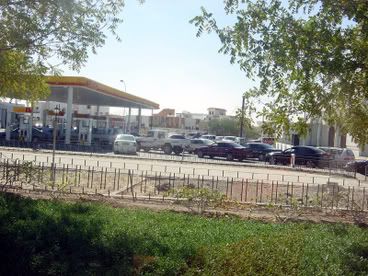
Outta gas! in Oman :: The Muscatis

Quote:
Petrol stations have been running out of gas for the past few days. Yesterday I had to drive to three stations till I found one with petrol to fill in. We got a call from someone who works in one of the oil companies about ten days ago warning us that a shortage was coming up and we should't let our car tanks empty. I guess I should have listened to his advice, but a week had passed since he told us and things seemed to be normal till all of a sudden yesterday one station after another started turning away customers.

Apparently the three filling station companies are alloted quotas by Oman Refinery based on orders which they give in advance every three or four months. The last time they placed orders was before the UAE increased their fuel prices and now due to the large numbers of UAE residents in border towns like Buraimi who come in to fill their cars in Oman the petrol supply is running out before the end of the quota period.
This is the sort of thing that gets the economist's blood pumping. And you read it first in Muscati's blog, not the newspaper.

Interesting lesson for those traveling from the UAE into Oman: you may want to tank up with more expensive UAE gasoline before entering Oman.

UPDATE: Coincidently travelled to Oman today to visit Hanging Gardens. Below is a photo I shot of the gas line at the Shell Station - it may be the station Brn mentions in the comments.
Image hosted by Photobucket.com
Most of the cars in this line are from the UAE. I enjoy the irony of residents from an oil-rich country country like the UAE crossing the border to buy gasoline cheaper in Oman. I suggest the only solution is for Oman to raise the price of gasoline. Not wishing to wait in line we made sure to refill while still in the UAE.

Another picture here.

Labels: , ,

Friday, December 02, 2005

Image:Dabba.jpg - Wikipedia, the free encyclopedia

Well that's funny. Someone at Wikipedia is using a photo I took, and not giving me credit. Hey, world, that's my photograph.

"Northeast of Dabba, Oman" is one of my evergreen posts. It generates 15 or so hits a week from google image searches.

Labels:

Tuesday, November 22, 2005

Business calls for better education in Arab world :: MENAFN

Read the whole article.

Here are some excerpts:

Unemployment is a major problem facing countries in the region. In Saudi Arabia, for example, the jobless rate stands at 9.6 per cent, while in Bahrain and Oman, respectively, 16.6 per cent and 15 per cent of the populations are unemployed. And the educational systems in the region are doing little to give students the skills with which to avoid joblessness. "They are based on memorisation rather than problem solving and creative solutions", said Gabr. He argues that there is a disconnect between the education curriculum and the requirements of the labour market, forcing businesses to waste a lot of effort and time on on-the-job training. . . .

Even though all the Gulf states have imposed legal quotas for companies to hire local nationals, companies tend to complain that nationals cost more and work less hard than expatriates. Metin Mitchell, managing director for the Middle East with Korn/Ferry International, a recruitment consultancy that headhunts for top management posts, said fostering a strong work ethic among Gulf nationals is more important than education. That's important, he said, because "burgeoning economies thrive when people work long and hard." But Mitchell said employers are also concerned with the rote learning educational systems of the Gulf, especially in Saudi Arabia, which emphasise memorisation rather than reasoning. . . .

Observers note that Arab education woes are so grave that in a small country like Bahrain, which is considered to have a more advanced education system than its neighbours, persistently high unemployment is still mostly attributed to an inadequately educated workforce. Officials from the Bahrain National Competitiveness Council said recently that the country's primary and secondary schools need a sweeping overhaul of curricula, teachers, management and physical infrastructure. . . .

Bahrain's default in education is being reflected even among its affluent fellow members of the Gulf Cooperation Council: Saudi Arabia, Kuwait, Qatar, United Arab Emirates and Oman. . . .

(Dow Jones)

Labels: , , ,